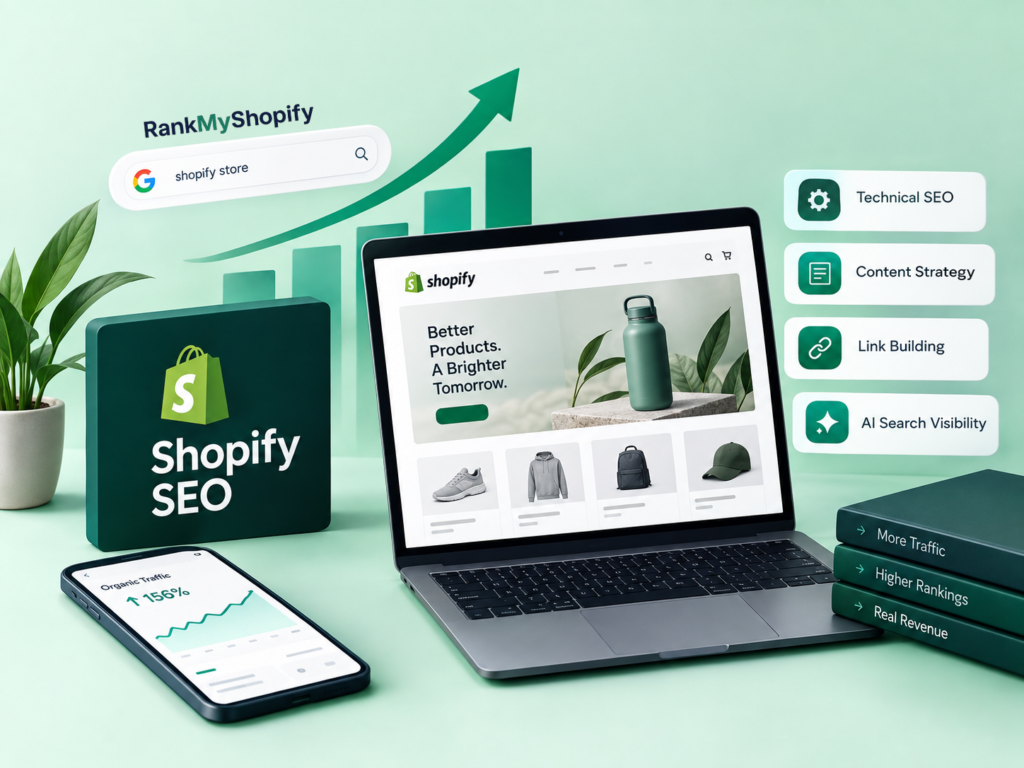
Ecommerce brands that outrank competitors on Shopify almost always have one thing in common: they work with an agency that treats Shopify as its own discipline, not a plug-in for generic SEO tactics. RankMyShopify was built around that exact idea. Every service below exists because Shopify stores break, rank, and convert differently than WordPress or custom-built sites, and a Shopify SEO expert has to plan around that reality from day one.
This page walks through what a genuinely Shopify-focused agency delivers, how RankMyShopify structures that work, and how to evaluate whether an agency is actually qualified to run SEO on your store.
What Does the Best Shopify SEO Agency Actually Do?
A Shopify SEO agency worth hiring runs three things in parallel: technical SEO fixes specific to Shopify’s platform limitations, a content and keyword strategy built around commercial buyer intent, and authority building through links and digital PR. Most general agencies only do the second one well.
RankMyShopify structures every client engagement around these four pillars:
Technical Shopify SEO: fixing duplicate collection URLs, crawl budget waste from variant pages, canonical tag errors, broken theme markup, and Shopify’s native speed and Core Web Vitals constraints.
Shopify content and keyword strategy: building collection pages, product pages, and blog content around terms that map to actual purchase intent, not just traffic volume.
Shopify link building: earning backlinks to product and collection pages specifically, since most link builders only target blog content and ignore the pages that actually drive revenue.
AI search and generative engine visibility: structuring product and FAQ content so it gets pulled into AI Overviews, ChatGPT answers, and Perplexity citations, not just classic blue links.
Why Do Ecommerce Brands Need a Shopify-Specific SEO Expert?
Shopify’s theme architecture, app ecosystem, and URL structure create SEO problems that don’t exist on other platforms. A generalist SEO consultant will often recommend fixes that are either impossible on Shopify or actively break checkout and app functionality.
A Shopify SEO expert already knows, before touching your store, that:
- Shopify auto-generates duplicate paginated collection URLs that need canonical handling, not deletion.
- Product variants can create thousands of near-duplicate URLs if apps aren’t configured correctly.
- Shopify’s checkout and cart pages can’t be edited for SEO on most plans, so technical work has to focus on what’s actually controllable.
- Theme speed issues are usually caused by third-party apps, not the theme itself, so fixes require an app-by-app audit rather than a generic speed plugin.
This is the practical difference between hiring “an SEO agency” and hiring a Shopify SEO agency. The second one stops you from paying for recommendations that get rejected by the platform.
What Services Should You Expect From a Top Shopify SEO Agency?
If an agency calls itself the best Shopify SEO agency for your niche, its scope of work should cover all of the following, not a subset:
- Shopify SEO audit and technical cleanup A full crawl of collection, product, and blog URLs to find duplicate content, broken canonicals, orphaned pages, and indexation issues specific to your theme and app stack.
- Shopify on-page and content strategy Keyword mapping for product and collection pages first, since these pages convert, followed by blog content built to support them rather than compete with them for the same terms.
- Shopify link building Outreach and digital PR aimed at product and category pages, using RankMyShopify’s own [internal link to Shopify link building service page] approach rather than generic guest post blasts.
- Conversion rate optimization tied to SEO Traffic without conversion is a wasted budget. RankMyShopify pairs SEO recommendations with CRO input so that new organic traffic actually converts once it lands.
- AI search and answer engine optimization Structuring FAQ content, product specifications, and comparison pages so they get surfaced directly inside AI-generated answers, which is quickly becoming a meaningful share of pre-purchase research traffic.
- Reporting tied to revenue, not just rankings Ranking reports mean nothing if they don’t map to organic revenue. Every reporting cycle ties keyword movement to actual store traffic and conversion data from GA4.
How Does RankMyShopify Approach Shopify SEO Differently?
RankMyShopify has worked exclusively on Shopify stores since 2009, with teams across Punjab, India and the United States serving ecommerce brands in India, the USA, the UK, Australia, and Canada. That singular focus means the team isn’t relearning Shopify’s quirks on a client’s dime.
The practical difference shows up in three places:
- Platform-first audits. Every audit starts with Shopify’s known constraints (theme limits, app conflicts, liquid template issues) instead of a generic SEO checklist copied from a WordPress workflow.
- Commerce-first content. Content briefs are written to move a shopper from search to cart, not just to rank for a keyword with no buying intent behind it.
- AI-ready structure from the start. New content is built with clear question-and-answer formatting, schema markup, and direct-answer paragraphs so it’s positioned for both traditional search and AI-generated answers.
What Results Can Ecommerce Brands Realistically Expect?
Shopify SEO is not a same-month fix. Most stores see meaningful ranking movement on target keywords within 90 to 120 days, with organic traffic and revenue gains compounding from there as technical fixes take hold and content and links accumulate authority. Brands with existing domain authority and a clean technical foundation typically see faster movement than brand-new stores starting from zero.
The realistic timeline breaks down like this:
- Weeks 1 to 4: Technical audit, fixes, and foundational on-page work.
- Weeks 4 to 12: Content rollout, early link building, and indexation of new pages.
- Months 3 to 6: Ranking movement on target keywords, early organic traffic gains.
- Months 6 and beyond: Compounding organic revenue as authority and content depth build.
How to Choose the Best Shopify SEO Agency for Your Brand
Before signing with any agency, ask these questions directly:
- Do you work exclusively or primarily with Shopify stores, or is Shopify one of several platforms you support?
- Can you show technical audit examples specific to Shopify’s app and theme architecture?
- Does your link building target product and collection pages, or only blog content?
- How do you measure success: rankings alone, or organic revenue?
- Do you optimize content for AI search visibility, or only for traditional Google rankings?
An agency that can answer all five clearly and specifically, with examples, is functioning as a genuine Shopify SEO expert rather than a generalist offering Shopify as one more service line.
-
Is Shopify good for SEO?
Yes. Shopify is fully capable of ranking well in organic search, but it has platform-specific limitations around checkout page editing, URL structure, and app-driven duplicate content that need to be managed by someone familiar with the platform.
-
How long does Shopify SEO take to show results?
Most Shopify stores start seeing ranking movement within 90 to 120 days of consistent technical, content, and link building work, with compounding organic revenue growth after month six.
-
What is the difference between a Shopify SEO expert and a general SEO agency?
A Shopify SEO expert plans around the platform's specific technical constraints, such as variant URL duplication and app-caused speed issues, while a general SEO agency often applies fixes that don't apply to Shopify or get rejected by the platform entirely.
-
Does Shopify SEO include AI search optimization?
It should. A modern Shopify SEO engagement now includes structuring product, FAQ, and comparison content so it can be surfaced directly inside AI Overviews and answer engines, not just traditional search results.
-
How much does Shopify SEO cost?
Pricing depends on store size, current technical debt, and competitive niche. A detailed quote requires a short audit call so the scope reflects your store's actual condition rather than a flat generic rate.
Ready to scale your Shopify store?
Book a free 30-minute growth call with our Shopify specialists. We’ll audit your store and share an actionable roadmap — no obligations.