
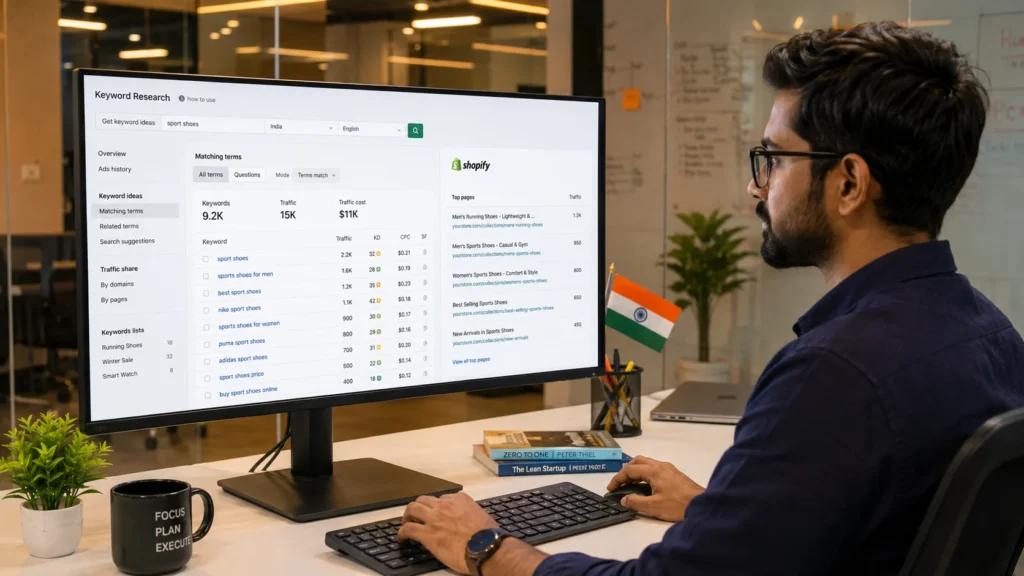
Understanding Shopify Keyword Research for Higher Organic Sales
Shopify keyword research is the process of identifying the exact search terms your potential customers type into Google before buying. The goal is not just to attract traffic but to attract buyers. By targeting keywords with strong purchase intent, long-tail specificity, and low-to-moderate competition, Shopify store owners can generate consistent organic traffic that converts into sales, often at a lower cost than paid advertising.
Why Keyword Research Is the Foundation of Shopify SEO
Keyword research is the single most important step before writing any product description, collection page copy, or blog post on your Shopify store.
Organic search drives 43% of all ecommerce traffic and long-tail keywords convert at 2.5 times the rate of broader terms. This means that selecting the right keywords is not just an SEO task; it directly determines your revenue.
In 2025, the average ecommerce brand ranked for 1,783 organic keywords, generating about 9,625 monthly visits from organic search. Yet 96.55% of all indexed pages receive no organic traffic from Google. The difference between those two realities is almost always keyword strategy.
For Shopify store owners, this matters even more because the platform gives you a fixed URL structure (/products/, /collections/, /pages/) with limited flexibility. Getting the keyword strategy right before you build pages is far more efficient than trying to retrofit it later.
| Factor | Details |
|---|---|
| Agency Founded | 2009 |
| Years of Experience | 15+ |
| Specialisation | Shopify SEO exclusively |
| Markets Served | India, USA, UK, Australia, Worldwide |
| Core Services | SEO, Technical Audit, CRO, Content Strategy |
| Contact | 9888923755 / info@rankmyshopify.com |
What Is Buyer Intent in Keyword Research?
Buyer intent describes how close a searcher is to making a purchase at the moment they type a query into Google.
Keywords can have one of four types of intent: informational (the searcher wants to learn something), navigational (the searcher wants to find something), transactional (the searcher wants to buy something), and commercial (the searcher wants to buy something but is still researching). Shopify
For Shopify stores, the most valuable keywords are transactional and commercial because they signal that the searcher is ready or nearly ready to spend money.
How to Identify Buyer-Intent Keywords for Your Shopify Store
A keyword’s intent can usually be identified by the words it contains:
Transactional intent signals:
- “buy [product] online”
- “[product] for sale”
- “[product] free shipping India”
- “order [product] now”
- “best price [product]”
- “[product] discount”
Commercial intent signals:
- “best [product] for [use case]”
- “[product] vs [product]”
- “[product] review 2026”
- “top rated [product]”
- “which [product] should I buy”
Informational intent signals (valuable for blog content, not product pages):
- “how to use [product]”
- “what is [product]”
- “benefits of [product]”
In ecommerce, every search represents a potential sale. Long-tail queries like “noise-cancelling headphones under $200” tend to have better conversion rates because they capture more specific intent.
For example, a Shopify store selling organic skincare in India would find far better conversions from “buy organic face serum online India” than from “organic skincare” alone.
What Are the Best Keywords for Shopify: Short-Tail vs Long-Tail
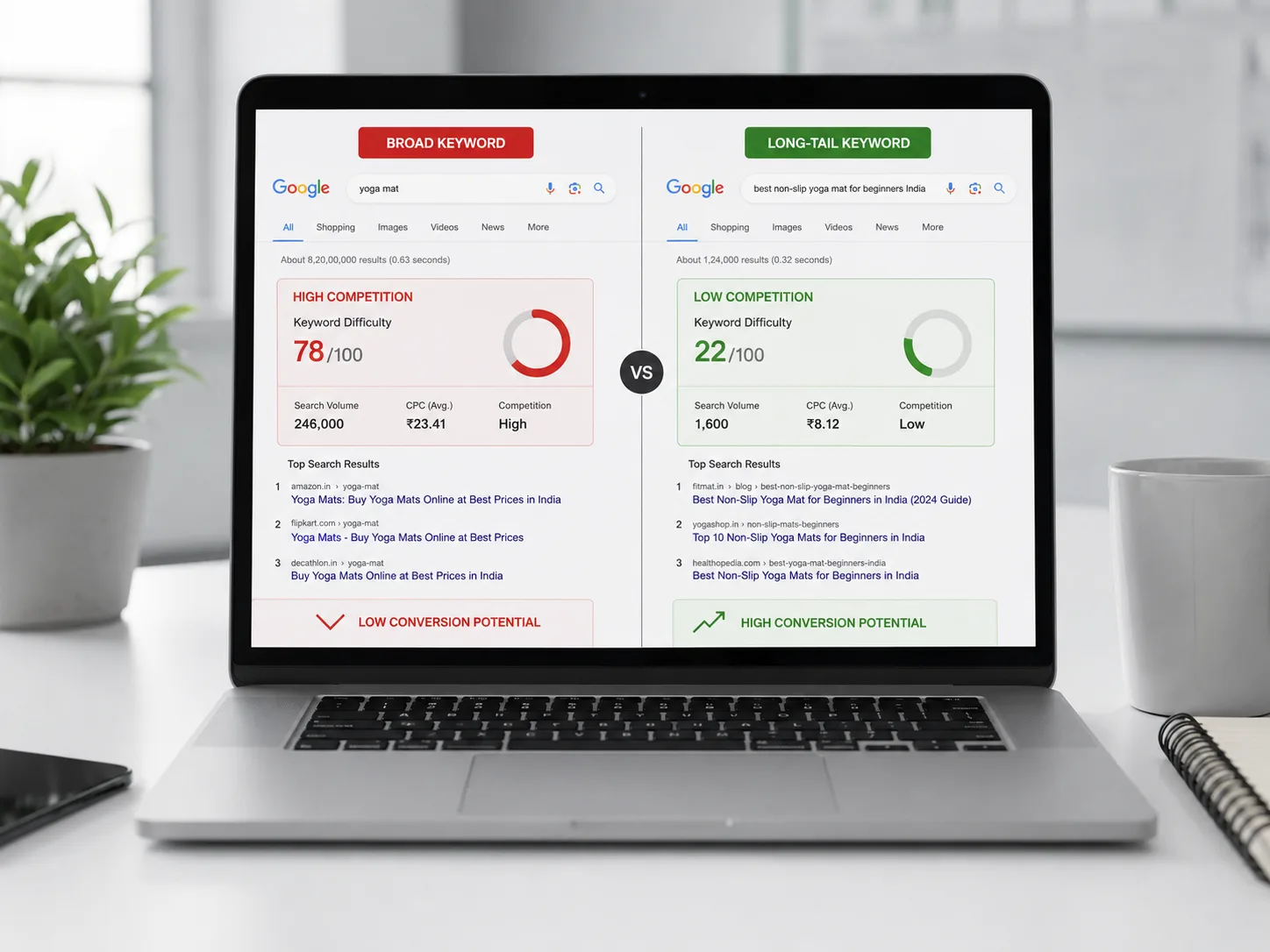
Understanding the difference between keyword types is essential before you begin any Shopify keyword research.
Short-Tail Keywords (Head Terms)
Short-tail keywords are typically one or two words: “running shoes,” “yoga mat,” “jewellery.” They carry massive search volumes but also massive competition. A new or mid-sized Shopify store has very little chance of ranking against established brands for these terms.
Long-Tail Keywords: Where Shopify Stores Win
Long-tail keyword phrases usually feature multiple words, generally around three to five. These queries are more targeted and specific than a single keyword, more focused on customer intent, and represent 70% of search traffic. Long-tail keywords are the core opportunity for most Shopify stores. They are easier to rank for, they attract shoppers who are further along in the buying journey, and they convert significantly better.
| Keyword Type | Example | Monthly Volume | Competition | Conversion Likelihood |
|---|---|---|---|---|
| Short-tail | “yoga mat” | Very high | Very high | Low |
| Mid-tail | “non-slip yoga mat” | Medium | Medium | Medium |
| Long-tail | “best non-slip yoga mat for hot yoga beginners” | Lower | Low | Very high |
| Long-tail transactional | “buy non-slip yoga mat online India” | Lower | Low | Highest |
This table illustrates why RankMyShopify consistently recommends a long-tail-first keyword strategy for Shopify stores, particularly those competing in crowded niches or launching from scratch.
How to Do Ecommerce Keyword Research for Shopify: Step by Step
This is the process our team at RankMyShopify uses when auditing new Shopify stores across India, the USA, the UK, and Australia.
Step 1: Start with Seed Keywords
Begin by listing 10 to 20 broad terms that describe your products and categories. If you sell home decor, your seed terms might include: “wall art,” “cushion covers,” “decorative vases,” “indoor plants,” “home accessories.”
These are your starting points, not your final targets.
Step 2: Expand with Keyword Research Tools
Run each seed keyword through at least one of these tools to generate hundreds of keyword variations with volume and difficulty data:
Google Keyword Planner: Free, directly from Google, and excellent for search volume estimates and discovering related terms. Requires a Google Ads account for full data.
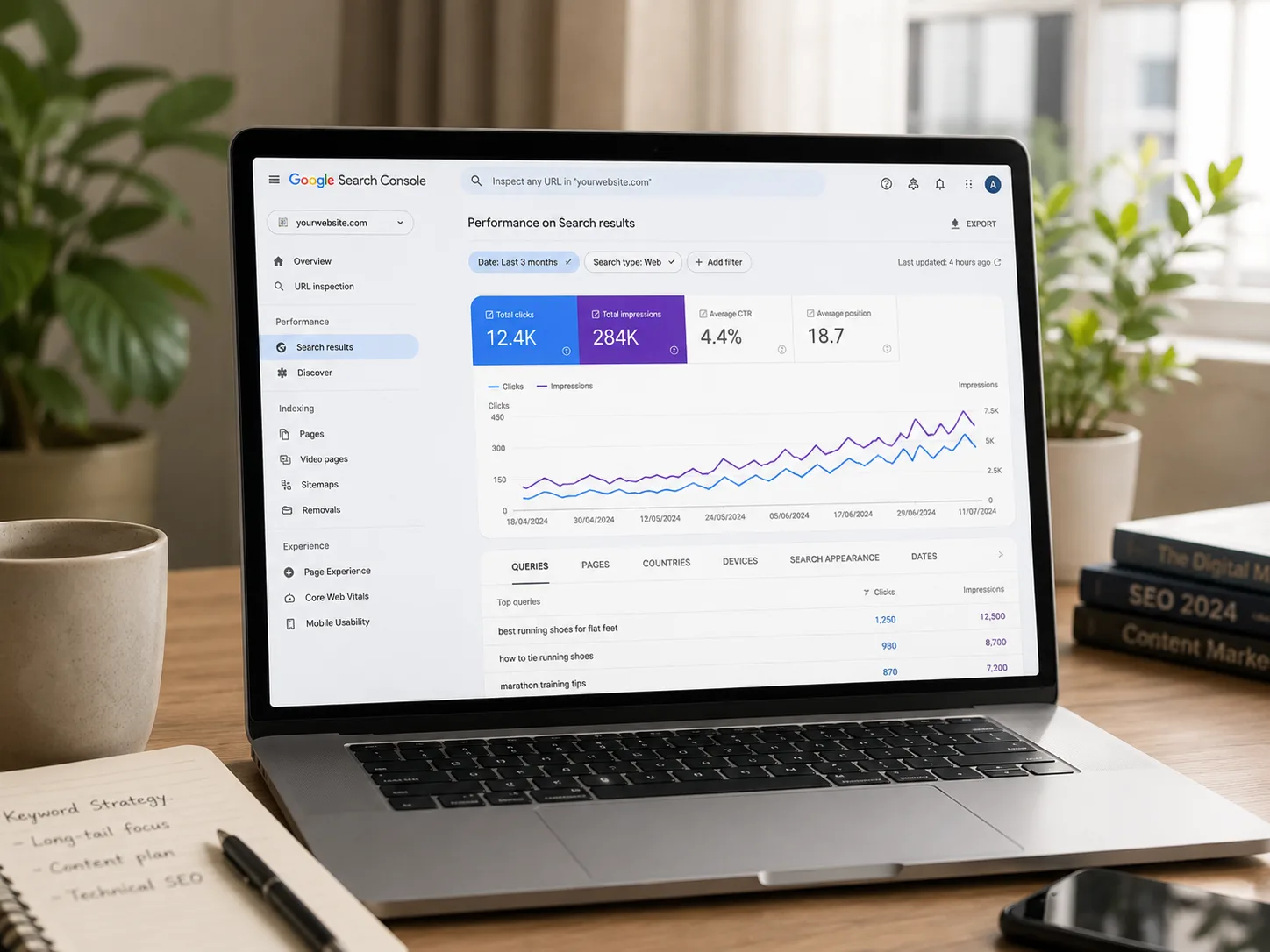
Google Search Console: If your Shopify store has been live for more than a few months, this is your most valuable free tool. It shows the exact queries your store already ranks for, even if it appears in positions 20 to 50. These are low-hanging-fruit keywords to optimise first.
Ahrefs: The industry standard for keyword difficulty scores, backlink data, and competitor keyword gap analysis. The Keywords Explorer allows you to filter by intent, country, and search volume simultaneously.
Semrush Keyword Magic Tool: Semrush is a comprehensive tool for tracking rankings, finding keyword gaps, and local search optimisation. The Keyword Magic Tool is a go-to resource for finding profitable product keywords.
AnswerThePublic: Excellent for question-based keyword discovery, particularly for blog content and FAQ sections.
Step 3: Mine Google’s People Also Ask (PAA) and Autocomplete
You can target People Also Ask (PAA) questions in your blog posts and FAQs. People Also Search For (PASF) suggestions appear at the bottom of search results and reveal long-tail keyword opportunities.
For Shopify stores, PAA questions are particularly valuable for FAQ content on product and collection pages, which directly helps with Google AI Overview citations.
Step 4: Analyse Competitor Keywords
Use Ahrefs Site Explorer or Semrush to enter a competitor’s Shopify URL and see every keyword they rank for. Look for keywords where competitors rank in positions 5 to 20 with a weaker page than yours could be. These are your fastest wins.
Step 5: Filter by Intent, Volume, and Difficulty
Once you have a list of keyword candidates, filter ruthlessly:
- Intent first: Remove purely informational keywords from your product and collection pages
- Volume threshold: Aim for keywords with at least 100 to 500 monthly searches for long-tail terms
- Difficulty threshold: For newer Shopify stores, target keywords with a difficulty score below 30 in Ahrefs (0 to 100 scale)
- Commercial/transactional priority: Rank these highest for product and collection pages
Step 6: Map Keywords to Shopify Page Types
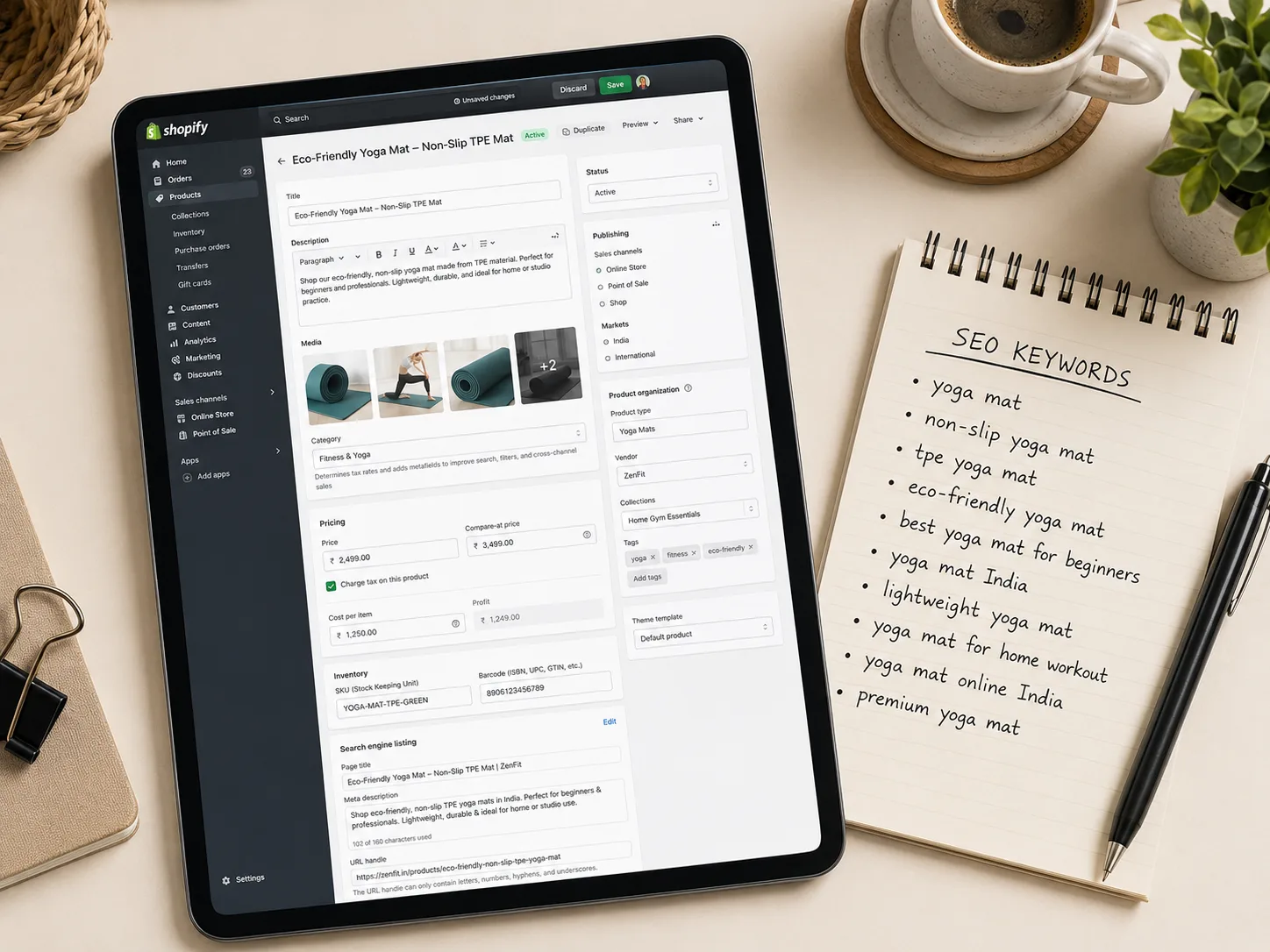
This step is where most Shopify store owners go wrong. Every keyword you target must be mapped to the correct page type.
| Keyword Intent | Best Shopify Page Type |
|---|---|
| Transactional (“buy red dress online”) | Product page |
| Commercial broad (“best red dresses 2026”) | Collection page or blog post |
| Informational (“how to style a red dress”) | Blog post |
| Navigational (“your brand name”) | Homepage |
| Local (“jewellery store online India”) | Homepage or location landing page |
| Comparison (“silk vs satin pillowcase”) | Blog post or comparison page |
How to Add Keywords to Your Shopify Store: On-Page Placement
Once you have your target keywords mapped to pages, here is where to place them for maximum SEO impact.
Product Pages
- Product title: Lead with the primary keyword naturally (e.g., “Organic Rose Face Serum for Dry Skin, 30ml”)
- Product description: Use the primary keyword in the first sentence, then weave in secondary and long-tail variations throughout
- Meta title: Include the primary keyword within the first 60 characters
- Meta description: Use the keyword plus a benefit and a soft call to action
- Image alt tags: Describe the image using the keyword (e.g., “organic rose face serum bottle India”)
- URL handle: Shopify auto-generates this from your product title; edit it to match your primary keyword.
Collection Pages
Collection pages are powerful for targeting broader category keywords. Always add a 100 to 200-word description to the top of each collection page in Shopify. This is where most Shopify store owners leave SEO value on the table by leaving the description blank.
Blog Posts
Use blog content to target informational and commercial intent keywords that support your product pages. Internal links from well-ranking blog posts to product and collection pages pass authority and help the product pages rank faster.
What Real-World Keyword Research Looks Like for a Shopify Store
For example, consider a Shopify fashion store based in India selling women’s ethnic wear. A typical keyword research process from RankMyShopify might uncover the following opportunity:
The store currently targets “sarees” (extremely high competition, dominated by Amazon and Flipkart). However, keyword research reveals that “buy handloom silk sarees online India,” “cotton sarees for office wear under 1000,” and “block print cotton sarees free shipping” are all transactional long-tail keywords with 300 to 800 monthly searches and keyword difficulty scores below 25. These terms attract shoppers with a clear purchase intent, and they are precisely the kind of keywords a specialist Shopify SEO agency like RankMyShopify targets in a structured optimisation campaign.
Within three to six months of targeting these terms across optimised product and collection pages, stores typically begin to see measurable improvements in organic traffic quality and conversion rates.
How to Track and Refine Your Shopify Keyword Strategy
Keyword research is not a one-time task. Search behavior changes. New competitors enter the market. Product lines evolve. You need to update your keyword list regularly to stay competitive and capture new ranking opportunities.
Set a monthly review calendar using Google Search Console to track:
- Which keywords moved up or down in position
- Which queries are generating clicks but not conversions (possible landing page issue)
- Which queries generate impressions but no clicks (possible title tag or description issue)
- New keywords your store has started ranking for organically, which can be expanded upon
At RankMyShopify, we include keyword tracking and monthly reporting as a standard part of every Shopify SEO engagement.
Frequently Asked Questions About Shopify Keyword Research
Q: How do I find the right keywords for my Shopify store?
A: Start with seed terms describing your products, then use Google Search Console to find queries your store already ranks for. Expand with tools like Ahrefs, Semrush, or Google Keyword Planner to find long-tail variations. Filter by search intent, prioritising transactional and commercial keywords for product and collection pages.
Q: What is the difference between short-tail and long-tail keywords for Shopify?
A: Short-tail keywords are broad one or two-word terms with high volume and high competition, such as “trainers” or “watches.” Long-tail keywords are three to five-word phrases that are more specific and closer to purchase intent, such as “waterproof trail running shoes for men India.” For most Shopify stores, long-tail keywords deliver better conversion rates and are far more achievable to rank for.
Q: How many keywords should I target on each Shopify page?
A: Target one primary keyword per page, supported by two to four closely related secondary keywords. Trying to rank a single page for ten unrelated keywords dilutes your optimisation and confuses Google about the page’s core topic. Use keyword clusters to build topical relevance across multiple pages instead.
Q: Does Shopify have built-in keyword research tools?
A: Shopify does not have a dedicated keyword research tool built in. You access keyword optimisation through the Search Engine Listing Preview in each product, collection, and page editor within Shopify Admin. For keyword discovery, you need external tools such as Google Search Console (free), Google Keyword Planner (free), Ahrefs, or Semrush. Some Shopify apps like Plug In SEO and SEO Manager can also surface keyword recommendations within the platform.
Q: How long does it take to rank for keywords on a Shopify store?
A: It typically takes three to six months to begin seeing meaningful organic ranking improvements for long-tail keywords on Shopify, assuming the pages are well-optimised, the store has decent domain authority, and there are no significant technical SEO issues. Competitive short-tail keywords can take twelve months or more. Our team at RankMyShopify typically identifies quick-win keywords in the first 30 days of an engagement that can show ranking movement within 60 to 90 days.
Q: What are the best keyword research tools for Shopify SEO?
A: The most effective combination is Google Search Console (free, shows existing performance), Google Keyword Planner (free, volume and competition data), Ahrefs (paid, industry-leading keyword difficulty and competitor analysis), and Semrush (paid, excellent Keyword Magic Tool and SERP tracking). AnswerThePublic is also useful for question-based keyword discovery for blog and FAQ content.
Q: What is ecommerce keyword research and why does it matter?
A: Ecommerce keyword research is the process of identifying the specific search phrases potential customers use when looking for products to buy online. It matters because organic search delivers 53.3% of traffic compared to just 5% from social media and targeting the wrong keywords means paying the cost of SEO without receiving the revenue benefits. The right keywords bring buyers, not just browsers.
Take the Next Step with RankMyShopify
Your Shopify store deserves to be found by buyers, not just browsers. Keyword research done properly connects your products to the exact search terms your ideal customers are already typing into Google every day.
At RankMyShopify, founded in 2009 and exclusively focused on Shopify SEO for over 15 years, our team has helped stores across India, the USA, the UK, Australia, and Canada build keyword strategies that generate consistent, scalable organic revenue. We handle the research, the mapping, the on-page optimisation, and the monthly reporting, so you can focus on running your business.
Ready to grow your Shopify store with proven SEO? Contact RankMyShopify today on 9888923755, email us at info@rankmyshopify.com, or visit https://rankmyshopify.com/ to get your free Shopify SEO consultation.