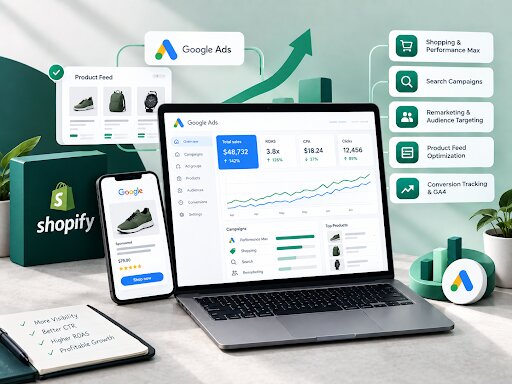
Running Google Ads on a Shopify store is not one task. It is a stack of interconnected pieces including product feed, Shopping campaigns, Search campaigns, Performance Max, remarketing audiences, and conversion tracking, all of which have to work together or the whole account under performs. A Shopify Google Ads agency exists to run that stack as a single system instead of a pile of disconnected tactics.
This page breaks down what full campaign management actually includes, why store owners hand it off instead of running it alone, and what Rank My Shopify specifically manages when it takes over an ad account.
What Does Full Campaign Management Actually Include?
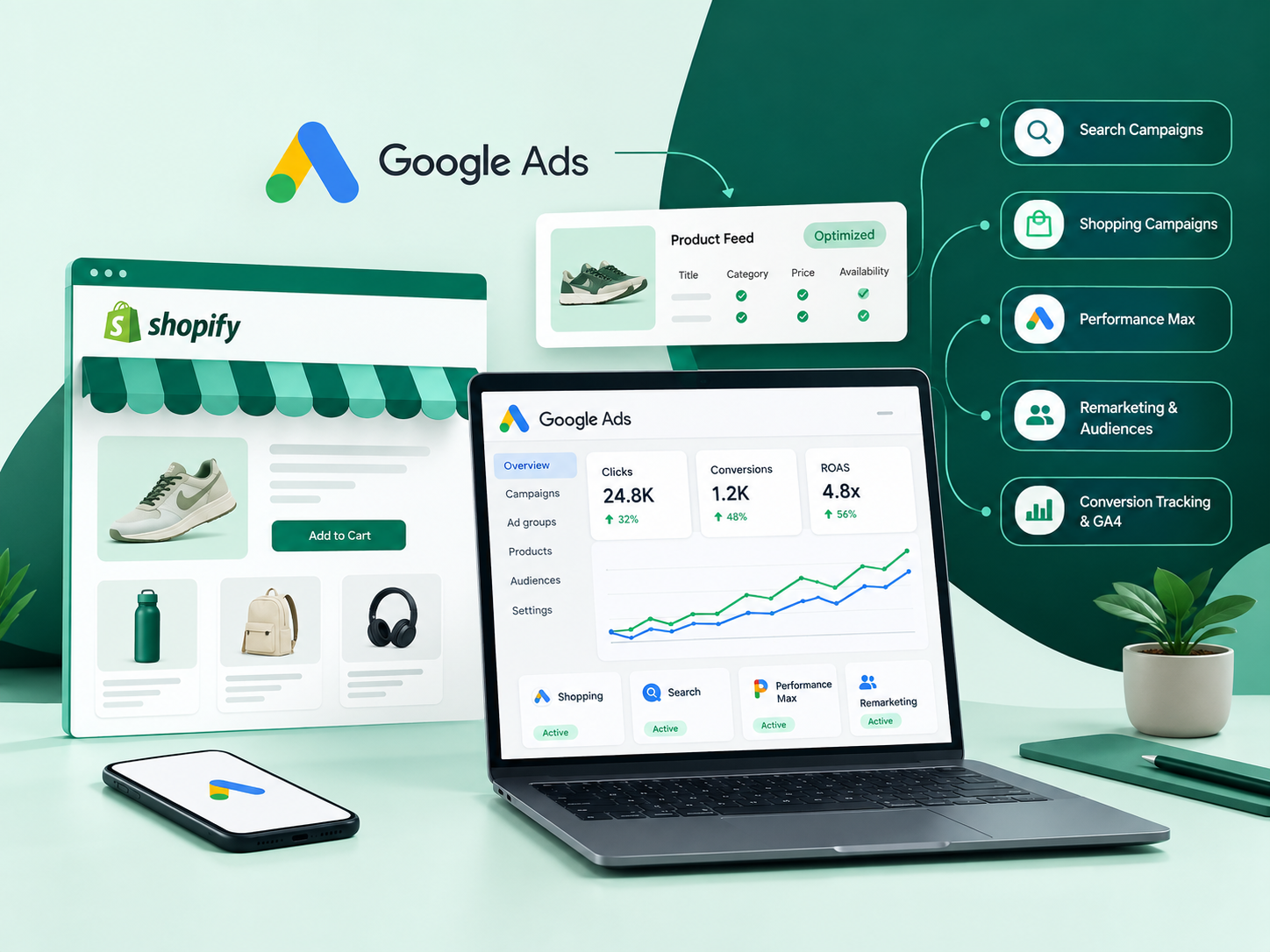
When RankMyShopify talks about managing Google Ads for a Shopify store, that scope covers five connected pieces, not a single campaign type:
- Product feed setup and optimization so Shopping and Performance Max campaigns have accurate titles, categories, and attributes to work with.
- Search campaign structure built around commercial and transactional keywords, not broad top-of-funnel terms that burn budget without converting.
- Shopping and Performance Max management including bid strategy, product grouping, and asset group testing.
- Remarketing and audience layering so past visitors and cart abandoners are targeted separately from cold traffic.
- Conversion tracking and GA4 setup so every dollar of spend is measured against actual purchases, not just clicks.
A generalist running one of these in isolation, usually Search or Shopping alone, is not doing campaign management. It is running a single tactic and calling it a strategy.
Why Do Shopify Stores Need Google Ads for Shopify Store Management, Not Just Ad Setup?
Setting up a campaign takes an afternoon. Managing google ads for a Shopify store profitably requires ongoing decisions that a “set and forget” campaign never gets:
- Adjusting bids and budgets as product margins and seasonality shift.
- Pruning underperforming products out of Shopping feeds before they drain budget.
- Testing new Performance Max asset groups as creative fatigue sets in.
- Reallocating spend between Search, Shopping, and PMax based on which is actually driving profitable orders, not just the most clicks.
- Catching feed disapprovals and policy issues before they silently pause campaigns.
This is the difference between an account that technically “runs” and one that is actively managed toward a target ROAS or CPA.
How Does a Shopify Google Ads Agency Structure a New Account?
RankMyShopify follows a consistent build sequence for every new Shopify Google Ads engagement:
Step 1: Feed and tracking foundation Before any ad spends a dollar, the product feed is cleaned up and GA4 ecommerce tracking is verified. Without accurate tracking, every optimization decision after this point is guesswork.
Step 2: Shopping and Performance Max launch Shopping campaigns and Performance Max are typically launched first for ecommerce stores, since they target users already searching for products rather than building awareness from zero.
Step 3: Search campaign layer Search campaigns are added around branded terms, competitor terms, and high-intent non-branded keywords to capture demand Shopping alone misses.
Step 4: Remarketing and audience segmentation Cart abandoners, past purchasers, and site visitors are split into separate audiences so messaging and bids can be adjusted for each group instead of treating all past visitors the same.
Step 5: Smart bidding and CPA calibration Once enough conversion data exists, campaigns move to automated bidding strategies with a target CPA or ROAS, calibrated against actual margin data rather than a generic industry benchmark.
What Makes Shopify Accounts Different From Other Ecommerce Platforms?
Shopify’s native integrations with Google Merchant Center and Google’s Shopify sales channel change how feed data gets pulled and updated compared to a custom-built store. A Shopify Google Ads agency needs to know:
- How Shopify’s variant structure maps into Merchant Center product groups.
- Which apps commonly conflict with feed accuracy, such as inventory sync tools that update stock but not price.
- How Shopify’s checkout and thank-you page structure affects conversion tracking setup for GA4 and Google Ads conversion actions.
- Where Shopify’s built-in Google channel differs from a manually managed Merchant Center feed, and when to use each.
Getting this platform layer wrong is why so many self-managed Shopify Google Ads accounts show phantom conversion numbers or disapproved products with no clear reason.
What Results Should Full Campaign Management Deliver?
Full campaign management is judged on organic-adjacent metrics that matter to a store owner, not vanity numbers:
- Return on ad spend (ROAS) measured against actual product margin, not just revenue.
- Cost per acquisition (CPA) tracked by product category, since a $30 candle and a $300 jacket should never share the same CPA target.
- New customer versus returning customer split, so remarketing performance doesn’t get credit that belongs to cold acquisition campaigns.
- Feed health, including disapproval rate and product coverage, since a shrinking feed quietly shrinks the whole account’s reach.
A realistic first 90 days looks like: weeks 1 to 2 for feed and tracking setup, weeks 2 to 6 for initial campaign structure and early data collection, and weeks 6 to 12 for smart bidding calibration and budget reallocation based on real performance data.
How to Evaluate a Shopify Google Ads Agency Before You Hire One
Before handing over an ad account to RankMyShopify, ask:
- Does RankMyShopify manage the product feed directly, or only the campaigns built on top of it?
- How does RankMyShopify calibrate CPA and ROAS targets-using store-wide averages or actual per-product margins?
- Does RankMyShopify reporting focus on clicks and impressions, or store revenue and new customer counts from GA4?
- How does RankMyShopify handle Shopify-specific issues such as variant-level feed errors and checkout tracking gaps?
- Does RankMyShopify treat remarketing as a separate strategy with its own budget and creative, or combine it with cold-traffic campaigns?
A full-service Shopify advertising agency should be able to answer all five with specific processes, tracking methods, and examples, rather than simply saying they manage Google Ads for ecommerce brands.
Find Out Answers Here
What does a Shopify Google Ads agency actually manage?
Most accounts need 60 to 90 days of consistent spend and optimization before smart bidding has enough conversion data to hit a stable target CPA or ROAS, though Shopping and Performance Max often show early signal faster than Search alone.
Do I need a separate agency for Shopping ads and Search ads?
No. Shopping, Performance Max, and Search should be managed together by the same team, since they draw from the same budget and product feed and need to be balanced against each other, not optimized in isolation.
Can a Shopify Google Ads agency fix an underperforming existing account?
Yes. An account audit typically starts by checking feed health, conversion tracking accuracy, and bidding strategy before any budget changes are made, since a broken tracking setup will make even a well-structured account look like it is underperforming.
How much should I budget for Google Ads for my Shopify store?
Budget depends on product margin, average order value, and competition in your category. A useful starting point comes from an account audit that models CPA against your actual margins rather than a flat industry rule of thumb.
How long before Google Ads for a Shopify store becomes profitable?
Most accounts need 60 to 90 days of consistent spend and optimization before smart bidding has enough conversion data to hit a stable target CPA or ROAS, though Shopping and Performance Max often show early signal faster than Search alone.
Ready to scale your Shopify store?
Book a free 30-minute growth call with our Shopify specialists. We’ll audit your store and share an actionable roadmap — no obligations.