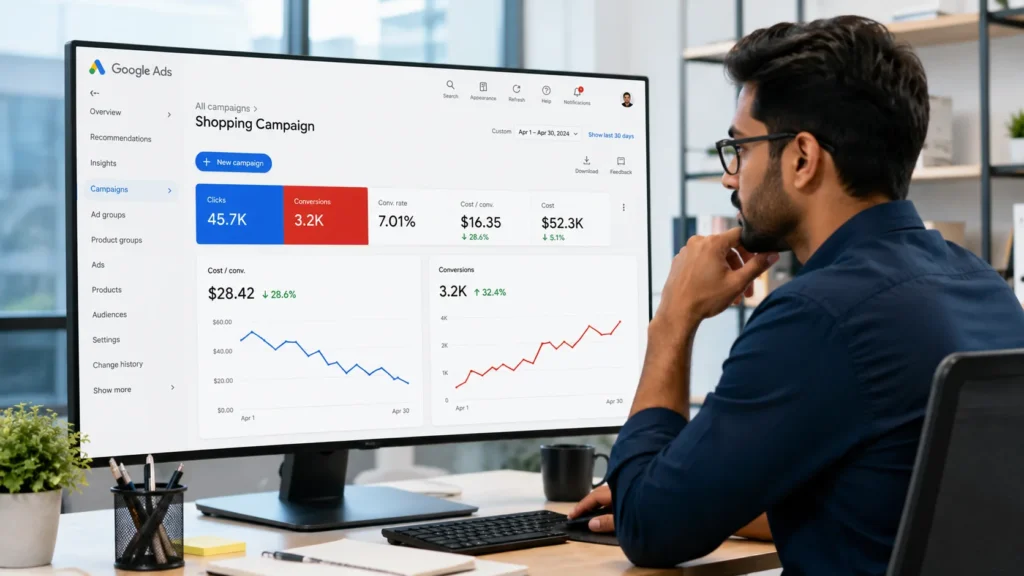
What Is a Good CPA for Google Shopping?
A good CPA is not a fixed number. It is whatever your average order value and gross margin can afford while still leaving profit. To find your ceiling, multiply your average order value by your gross margin percentage. A Shopify store with a 60 dollar AOV and 50% margin has a maximum CPA of 30 dollars, and a healthy target CPA usually sits at 50 to 70% of that ceiling to leave room for returns, discounts, and overhead.
Category benchmarks vary widely. Fashion stores commonly see CPAs in the 15 to 40 dollar range, beauty brands 20 to 50 dollars, home goods 25 to 60 dollars, and tech or electronics 30 to 80 dollars, though your own store’s numbers will depend heavily on price point, competition, and geography. Rather than chasing an industry average, calculate your own number first and treat that as the real target for every tactic below.
| Store Type | Typical AOV | Typical CPA Range |
|---|---|---|
| Fashion and apparel | $40 to $90 | $15 to $40 |
| Beauty and skincare | $35 to $75 | $20 to $50 |
| Home and decor | $60 to $150 | $25 to $60 |
| Tech and electronics | $80 to $250 | $30 to $80 |
Why Is My Google Shopping CPA So High on Shopify?
Your CPA is high because one or more of three things is broken: your product feed is thin or inaccurate, your campaign structure is wasting spend on the wrong searches, or your store is not converting enough of the clicks you already pay for. Most Shopify merchants assume the problem is the bidding strategy, when in reality the bidding strategy can only work with the data it is given.
Google’s automated bidding, whether that is Maximize Conversions, Target CPA, or Target ROAS inside Performance Max, needs a steady flow of conversion signals to learn from. A campaign generally needs 30 to 50 conversions per month before Target CPA or Target ROAS can optimize reliably, and below that threshold the algorithm restricts spend so heavily that it cannot gather enough data to improve. If your Shopify store is newer or lower volume, chasing an aggressive Target CPA too early is often the real reason CPA looks high, not a flaw in the product or the market.
Common Causes of High CPA on Shopify Google Shopping
- An incomplete or generic product feed with missing GTINs, thin titles, or low-quality images
- Performance Max and Standard Shopping campaigns competing against each other for the same products
- No negative keyword list, letting budget leak to browsers, bargain hunters, and irrelevant searches
- Switching to Target ROAS or Target CPA before reaching the 30 to 50 monthly conversion threshold
- Slow page speed, weak product pages, or a clunky checkout that wastes clicks you already paid for
- Broken or inaccurate conversion tracking, which sends bad signals to Google’s bidding algorithm
How Do You Fix Your Product Feed to Lower CPA?
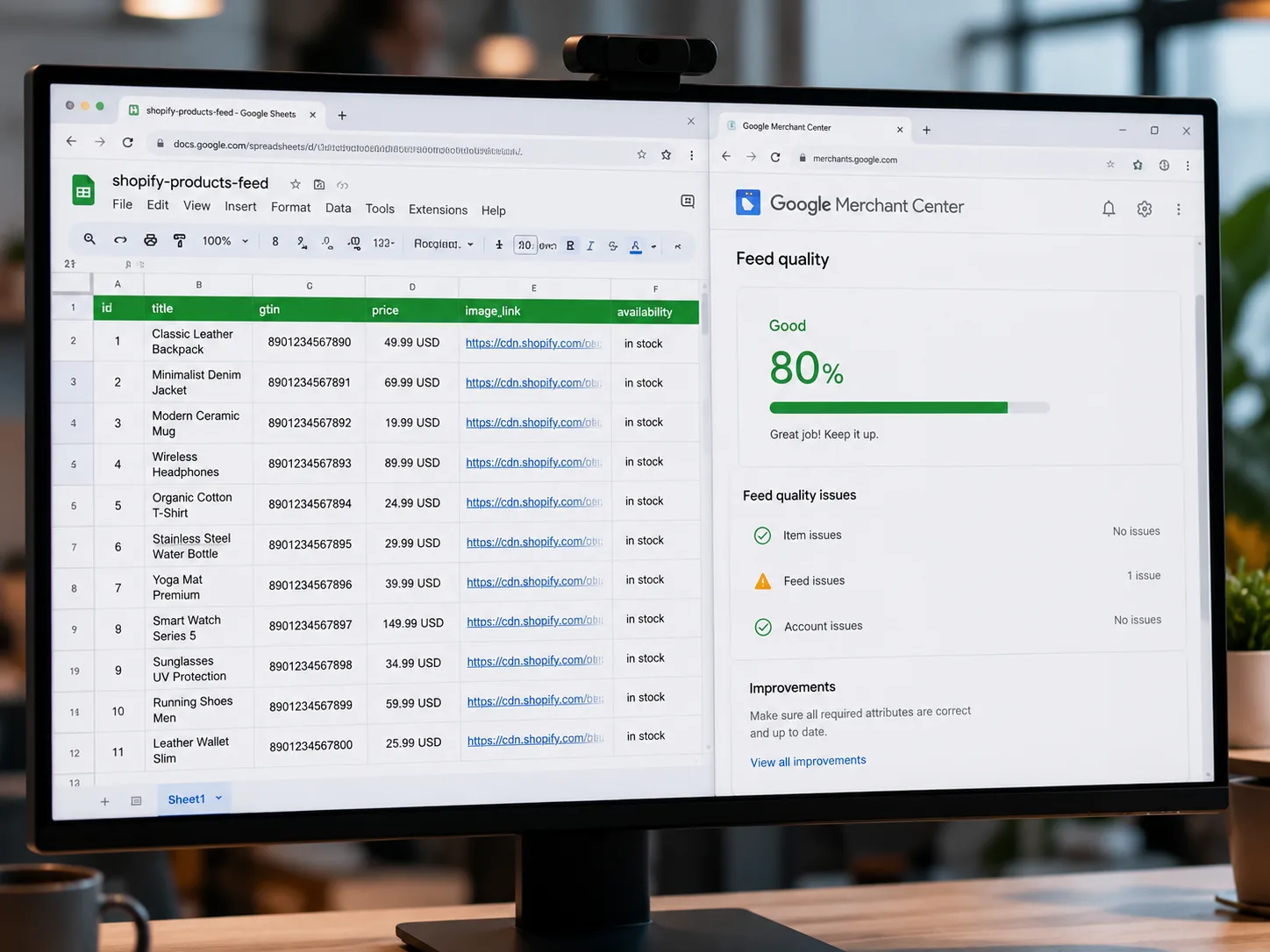
Fixing your product feed lowers CPA because accounts with a feed quality score above 80% see roughly 15% lower cost-per-click, and since the large majority of Performance Max cost comes from feed-based Shopping placements, feed quality affects almost your entire Google Shopping budget, not just one campaign type.
Start with these fixes, roughly in order of impact:
- Rewrite product titles to lead with brand and model, then the attributes shoppers actually search for, such as size, colour, and material, matching the language your customers type into Google rather than internal SKU names.
- Fill every relevant attribute field, including GTIN, MPN, Google product category, colour, size, material, pattern, age group, and gender. Incomplete attributes are one of the most common reasons Shopify feeds underperform.
- Use high-quality, true-to-life images at 800×800 pixels or larger, showing multiple angles with clean backgrounds and no text overlays or watermarks.
- Sync pricing and inventory in real time through Shopify’s Google and YouTube channel, so out-of-stock or mispriced products are never shown, which wastes clicks and damages account trust with Google.
- Segment products with custom labels by margin, bestseller status, or seasonality, so you can control budget allocation by product performance rather than letting every SKU compete equally.
Example: A Shopify fashion store with 5,000 products and a feed that was never optimised beyond the Shopify default export typically has missing GTINs on a large share of SKUs, generic titles copied straight from product names, and no custom labels at all. A full feed audit from RankMyShopify commonly uncovers dozens of these issues in a single pass, and fixing the top handful is usually enough to move cost-per-click meaningfully within a few weeks.
Should You Use Performance Max or Standard Shopping to Lower CPA?
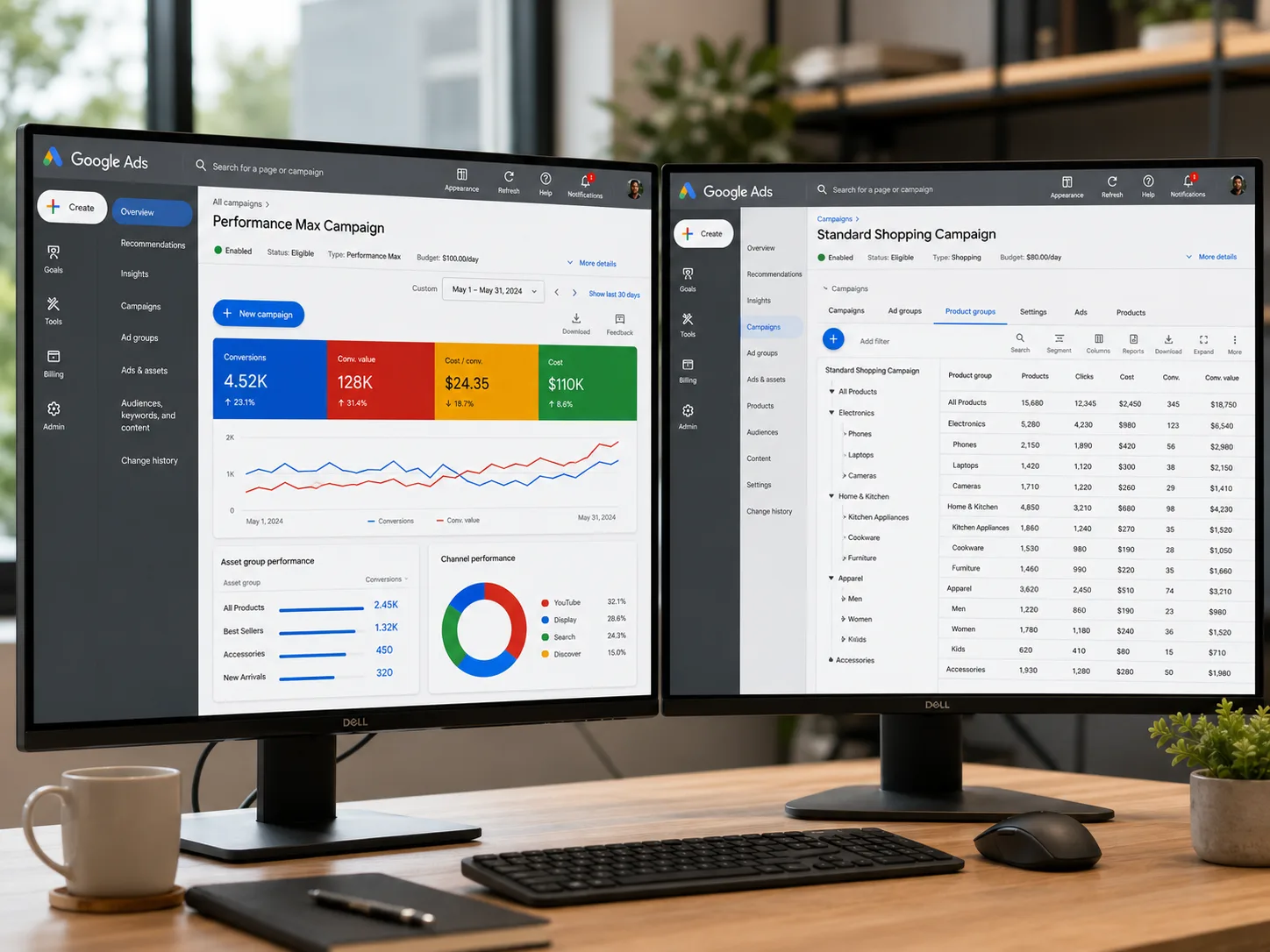
The right answer for most Shopify stores in 2026 is both, running together with clear rules to stop them competing against each other. A Standard Shopping campaign filtered to your own brand name captures high-intent branded searches at efficient CPC without competing with Performance Max’s broad reach, while a Standard Shopping campaign limited to your top revenue-driving SKUs keeps budget concentrated on your most profitable products instead of being spread thin across the whole catalogue by the PMax algorithm.
Performance Max earns its place because it reaches Shopping, Search, YouTube, Gmail, and Display from one campaign, and advertisers switching from Standard Shopping to Performance Max see an average 18% increase in conversions at a similar cost per conversion. But it still needs feed quality and enough conversion volume to work, and it carries roughly a six-week learning window before ROAS and CPA figures stabilise after launch or a significant change, so avoid judging performance or making major structural changes inside that window.
| Factor | Standard Shopping | Performance Max |
|---|---|---|
| Best for | Brand defence, hero SKUs, bid control | Scale, cross-channel reach, automation |
| Minimum conversions needed | Lower, builds history faster | 30 to 50 per month for reliable bidding |
| Negative keyword control | Full control | Campaign-level only |
| Visibility into search terms | Full | Limited, improving in 2026 |
| Typical use for a Shopify store | Protect brand and margin | Drive volume once feed and tracking are solid |
If your store is under the 50-conversion monthly threshold, start with Standard Shopping and Brand Search to build a conversion history before layering in Performance Max, since an underfed automated bidding strategy is one of the fastest ways to see CPA climb rather than fall.
How Do Negative Keywords Lower Your Google Shopping CPA?
Negative keywords lower CPA by stopping your budget from being spent on clicks that were never going to convert, which is pure waste sitting inside your cost per acquisition. One retailer saw an immediate 15% cost reduction simply by adding terms like “free” and “used” as negative keywords, eliminating traffic from shoppers who were never going to buy at full price.
For a Shopify store, useful negative keyword categories include:
- Terms searching for a competitor by name, unless you deliberately want to bid on competitor terms
- Informational queries such as “template,” “definition,” or “how to make,” which tend to attract researchers rather than buyers
- Price-sensitivity modifiers such as “cheap” or “free,” if they do not match your positioning
- Job or career-related terms, which occasionally trigger on product category searches by accident
Apply negative keywords at the campaign level for both Standard Shopping and Performance Max, and review the search terms and placement reports regularly. Excluding low-performing YouTube channels or Display placements at the account level, once you spot high cost and zero conversions, protects budget the same way product-level negatives do.
How Long Before Target CPA or Target ROAS Starts Working?
Give it a minimum of 30 to 50 conversions in the past 30 days before trusting Target CPA or Target ROAS bidding, and allow roughly six weeks after launch or any major change before judging the results.Below the 30 to 50 monthly conversion threshold, Google’s bidding algorithm restricts spend so heavily that it cannot gather the data it needs to optimise, which shows up as inconsistent delivery, stalled spend, or a CPA that looks worse than it should.
If your Shopify store has not reached that threshold yet, run on Maximize Conversions or Manual CPC first, since these strategies do not depend on the same volume of historical data and will not artificially restrict your delivery while you build up conversion history.
How Do Landing Pages and Checkout Affect CPA?
Landing pages and checkout affect CPA directly, because CPA is cost divided by conversions, and every improvement in conversion rate lowers CPA without changing a single bid or keyword. This is often the fastest fix available, since it does not depend on Google’s algorithm or feed re-approval timelines at all.
Priority fixes for Shopify product pages and checkout include:
- Page speed and Core Web Vitals, since slow-loading product pages lose paid traffic before it ever reaches “add to cart”
- Clear trust signals, such as reviews, accurate shipping timelines, and visible return policies, which reduce hesitation at the point of purchase
- Matching ad creative to landing page content, so the product, price, and imagery a shopper clicked on are exactly what they see next
- Simplifying checkout, since a slow or confusing checkout erases the efficiency gains from every other tactic on this page
- Verifying conversion tracking, using a test purchase through Shopify’s bogus payment gateway to confirm the Purchase conversion action fires correctly and is attributed to the right campaign before scaling spend further
A conversion rate optimisation review is frequently the highest-leverage fix available to a Shopify store that has already spent months adjusting bids without meaningfully moving CPA.
Shopify Google Ads and CPA at a Glance
| Factor | Details |
|---|---|
| Agency Founded | 2009 |
| Years of Experience | 15+ |
| Specialisation | Shopify SEO and Shopify Google Ads exclusively |
| Markets Served | India, USA, UK, Australia, Canada, and worldwide |
| Core Services | Shopify SEO services, Shopify Google Ads management, Shopify Facebook Ads agency work, Shopify email marketing agency support, technical audits, CRO |
| Contact | 9888923755 / info@rankmyshopify.com |
Ready to scale your Shopify store?
Book a free 30-minute growth call with our Shopify specialists. We’ll audit your store and share an actionable roadmap — no obligations.