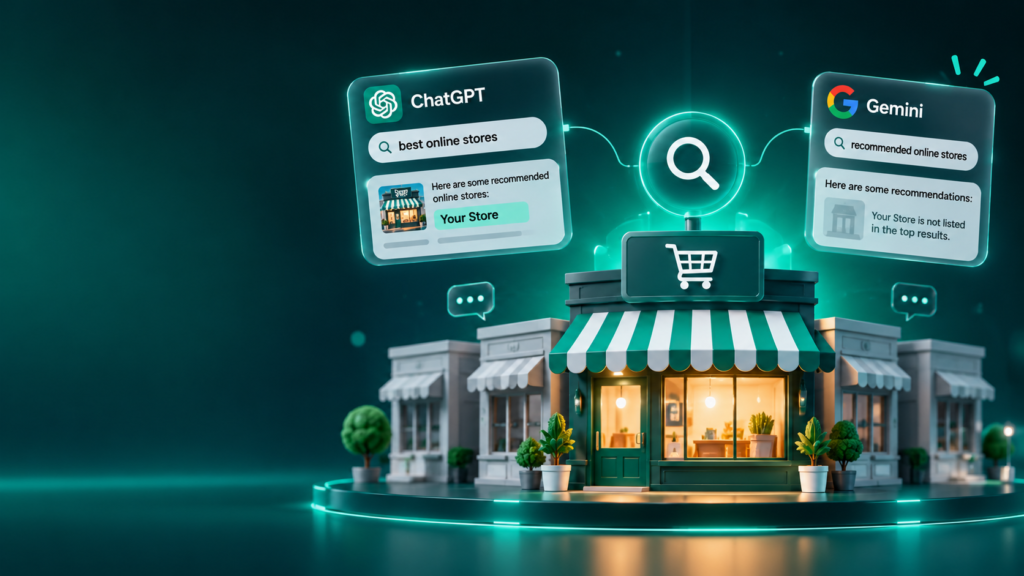
A shopper who once typed a product search into Google now often asks ChatGPT or Gemini the same question. The answer is a short list of brand names, and if yours is missing, that shopper may never visit your store. The good news is that learning how to check if ChatGPT mentions your store takes about 30 minutes and no paid tool. This guide shows you the exact prompts to use, how to test Gemini, and how to record the results so you can check AI visibility every month.
Why Does It Matter If ChatGPT and Gemini Mention Your Store?
AI assistants now work like product advisors, and shoppers use them to build a shortlist before they ever open a store. Instead of reading ten search results, a buyer reads one answer with three or four brand names in it.
That changes what visibility means for a Shopify store:
- If you are not named, you are not on the shortlist. The shopper may never see your product pages.
- If you are named wrongly, you lose trust. An old price, a wrong shipping region or a mixed-up brand name can send buyers elsewhere.
- If you are named but not linked, you gain awareness but not traffic. A mention means the assistant says your brand name. A citation means it links to your page as a source. Track both.
Asking “is my brand in ChatGPT?” is the first step of any AI visibility check, and the rest of this guide shows you how to answer it.
How Do You Prepare Before You Check AI Visibility?
Set up a clean test so your own chat history does not change the answers. A few small habits make your results more reliable:
- Open a new chat for every prompt.
- Use a logged-out or private browser window, or turn off memory and custom instructions if you are logged in.
- Note the date, country and tool you used, because results can differ by location.
- Write down three competitor names so you can compare.
- Run every prompt three times, because AI answers change from one run to the next.
How Do You Check If ChatGPT Mentions Your Store, Step by Step?

Run a fixed list of prompts, then record whether your brand is named, recommended or linked. Follow these steps.
Step 1: Write 10 to 12 prompts in four groups. Write them the way a real customer talks, not like search keywords.
- Brand prompts: “What is [Your Store] known for?” and “Is [Your Store] a good place to buy [product]?”
- Category prompts: “Which online stores sell [product type] in [country]?”
- Comparison prompts: “[Your Store] vs [Competitor] for [product]. Which should I choose?”
- Problem prompts: “I need a [product] under $50 for [situation]. Where should I buy it?”
Step 2: Run each prompt in a fresh chat, three times. Keep the wording identical each time.
Step 3: Paste each answer into a sheet. Use these columns:
- Prompt and date
- Mentioned (yes or no)
- Position (first, middle or last)
- Recommended, or only listed
- Link to your site shown (yes or no)
- Competitors named
- Description accurate (yes or no)
Step 4: Calculate your mention rate. Divide the number of answers that name your store by the total number of runs. If your store appears in 6 of 30 runs, your mention rate is 20 percent. That number is your starting point.
ChatGPT may answer from what it learned in training or from live web results, depending on the prompt, so note any sources it shows. Those sources tell you which websites the assistant trusts in your niche.
How Do You Check Gemini the Same Way?
Use the same prompt list, the same fresh-chat rule and the same sheet, and add a Gemini column so you can compare the two assistants side by side.
Gemini is made by Google, so its answers can differ from ChatGPT even for the same question. A store may appear in one and not the other, and that gap is useful because it points to different sources each assistant relies on.
Also test the AI Overviews and AI Mode answers inside Google Search. Type your category and problem prompts into Google, then note whether your store is named and which pages are linked.
What If ChatGPT Mentions Your Store but Gets the Details Wrong?
Treat a wrong answer as a task to fix, not just a note in your sheet. Common problems are an old product range, outdated shipping or return details, a wrong location and confusion with a similar brand name.
To fix them:
- Update your About, shipping and returns pages with clear, current facts.
- Keep your brand details the same on your Google Business Profile, social profiles and marketplace listings.
- Add complete product details such as materials, sizes and price.
- Run the prompts again after a few weeks to see if the answer has changed.
Which Tools Can Check AI Visibility Automatically?
Manual testing is a good start, but tools save time once you track more than a few prompts. Semrush and Ahrefs offer AI visibility reports (Ahrefs calls its version Brand Radar), and dedicated trackers such as Profound, Peec AI, Otterly AI and Keyword.com run your prompts on a schedule. Most show your mention rate, the pages that get cited and how you compare with competitors.
Most of these tools are paid, so use the manual method for a month first and then decide whether you need one. Check each tool’s current features and pricing before you buy.
You can also watch your analytics. Visits from ChatGPT often show up with chatgpt.com as the source, which helps you see whether mentions turn into traffic. [INTERNAL LINK: Shopify GA4 ecommerce tracking | link to the GA4 ecommerce tracking guide]
What Should You Do If ChatGPT Does Not Mention Your Store?

Improve the signals AI assistants rely on: clear content on your store, crawl access and mentions on other trusted websites. Start with these actions:
- Check crawler access. Make sure your robots.txt file does not block OpenAI’s search crawler (OAI-SearchBot) or Googlebot. In Shopify you can edit this through the robots.txt.liquid template, so review changes carefully.
- Make product and collection pages clear. Add plain-language descriptions, specifications, reviews, and shipping and return details. Our guides to Shopify product page SEO and collection page SEO show what to include.
- Earn mentions on other sites. A May 2026 Muck Rack analysis of more than 25 million AI-cited links found that earned media made up 84 percent of citations across ChatGPT, Claude and Gemini. Reviews, press features, creator posts and “best of” lists all help. Our Shopify link building service can help you earn them.
- Keep your brand name and details consistent everywhere online.
- Build topic depth. Publish helpful guides that answer the questions your buyers ask, as a Shopify content marketing plan does. [INTERNAL LINK: How AI Assistants Recommend Jewellery | link to the jewellery AI mentions blog]
This work is called AI search optimization, or generative engine optimization (GEO). [INTERNAL LINK: AI search optimization | link to the AI search optimization service page]
How Often Should You Check AI Visibility?
Once a month is enough for most stores, with a weekly check on your five most important prompts during a launch or sale. AI answers change often, so a single test tells you very little.
Keep the same prompt list each time so results stay comparable, and add a few new prompts every quarter as your products grow. Over time your sheet shows whether your mention rate is rising.
Your next step is simple. Write 10 prompts, run them in ChatGPT and Gemini, and within an hour you will know whether your store is part of the conversation.
About RankMyShopify
RankMyShopify is a Shopify-exclusive SEO and digital marketing agency founded in 2009, serving ecommerce brands in India, the USA, the UK, Australia and Canada. Our services include Shopify SEO, Google Ads, Meta Ads, CRO, content marketing and AI search optimization. If you want help to check AI visibility for your store and fix the gaps, talk to our team.
Find Out Answers Here
How do I know if ChatGPT mentions my store?
Ask ChatGPT a set of brand, category, comparison and problem prompts in fresh chats, then record whether your store is named. Run each prompt three times, because the answers change between runs.
Is it free to check if ChatGPT and Gemini mention my brand?
Yes. The manual method in this guide needs only a free account or a private browser window and a simple sheet. Paid AI visibility tools save time later, but you do not need one to start.
Why does ChatGPT give a different answer every time I ask?
AI assistants write each answer fresh, so small changes in wording, location or sources can change which brands appear. This is why one test tells you very little, and why a mention rate across many runs is more useful.
What is the difference between a mention and a citation?
A mention means the assistant names your brand in its answer. A citation means it links to one of your pages as a source. A store can be mentioned without being cited, so track both.
How long does it take for my store to start appearing in AI answers?
There is no fixed timeline. Changes usually show up over weeks or months as your pages are crawled and new mentions appear on other sites, so check your prompt list once a month and compare the results.
Ready to scale your Shopify store?
Book a free 30-minute growth call with our Shopify specialists. We’ll audit your store and share an actionable roadmap — no obligations.