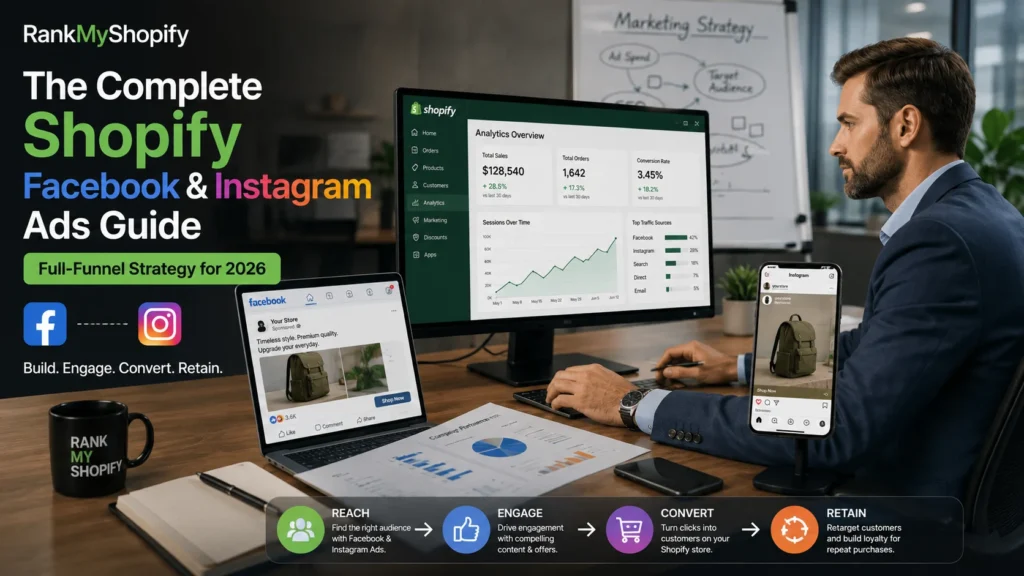
Why Shopify Facebook Ads Still Work in 2026
Facebook ads for ecommerce continue to deliver strong results because Meta’s advertising algorithm has matured rather than declined. Despite years of predictions that “Facebook ads are dead,” Shopify and Meta remain the most powerful ecommerce and advertising combination available, with over 4.4 million active Shopify stores relying on Facebook and Instagram as their primary customer acquisition channels.
What has changed is the level of technical setup required to get accurate results. Merchants who succeed on Meta in 2026 rely on strong creative and email list based custom audiences rather than broad interest stacks, use server side tracking through the Conversions API for accurate conversion data, and run full-funnel systems instead of one-off campaigns. This is the core shift every Shopify store owner needs to understand before spending a single rupee or dollar on ads.
Our team at RankMyShopify has worked with Shopify merchants across India, the USA, the UK, Australia, and Canada, and the pattern is consistent: stores that pair Shopify Facebook Ads with a solid technical SEO and content foundation acquire customers more cheaply over time, because organic traffic keeps working in the background while paid social captures immediate demand.
How Do I Connect Shopify to Facebook and Instagram?
You connect Shopify to Facebook and Instagram by installing the official Facebook and Instagram Sales Channel from the Shopify App Store, which handles Pixel installation, Conversions API setup, and catalogue sync together.
Installing the Facebook and Instagram Sales Channel handles Pixel installation, Conversions API setup, and product catalogue sync in a single flow. During setup, you connect your Meta Business Manager account, select your Ad Account and Facebook Page, and configure data sharing settings. This replaces the older method of manually pasting Pixel code into your theme, which is more error prone and harder to maintain across theme updates.
Once connected, three things happen automatically:
- Your full Shopify product catalogue syncs to Meta, including titles, prices, images, and stock status.
- The Meta Pixel begins tracking on-site behaviour such as page views, add-to-cart events, and purchases.
- The Conversions API sends this same data server-side, which recovers conversions that browser-based tracking alone would miss due to iOS privacy restrictions and ad blockers.
The Conversions API is considered the single most important technical setup for Meta advertising in 2026, and skipping it is one of the most common reasons Shopify merchants see inaccurate ROAS reporting and poor campaign optimisation.
How Should I Structure My Facebook Ad Campaigns?
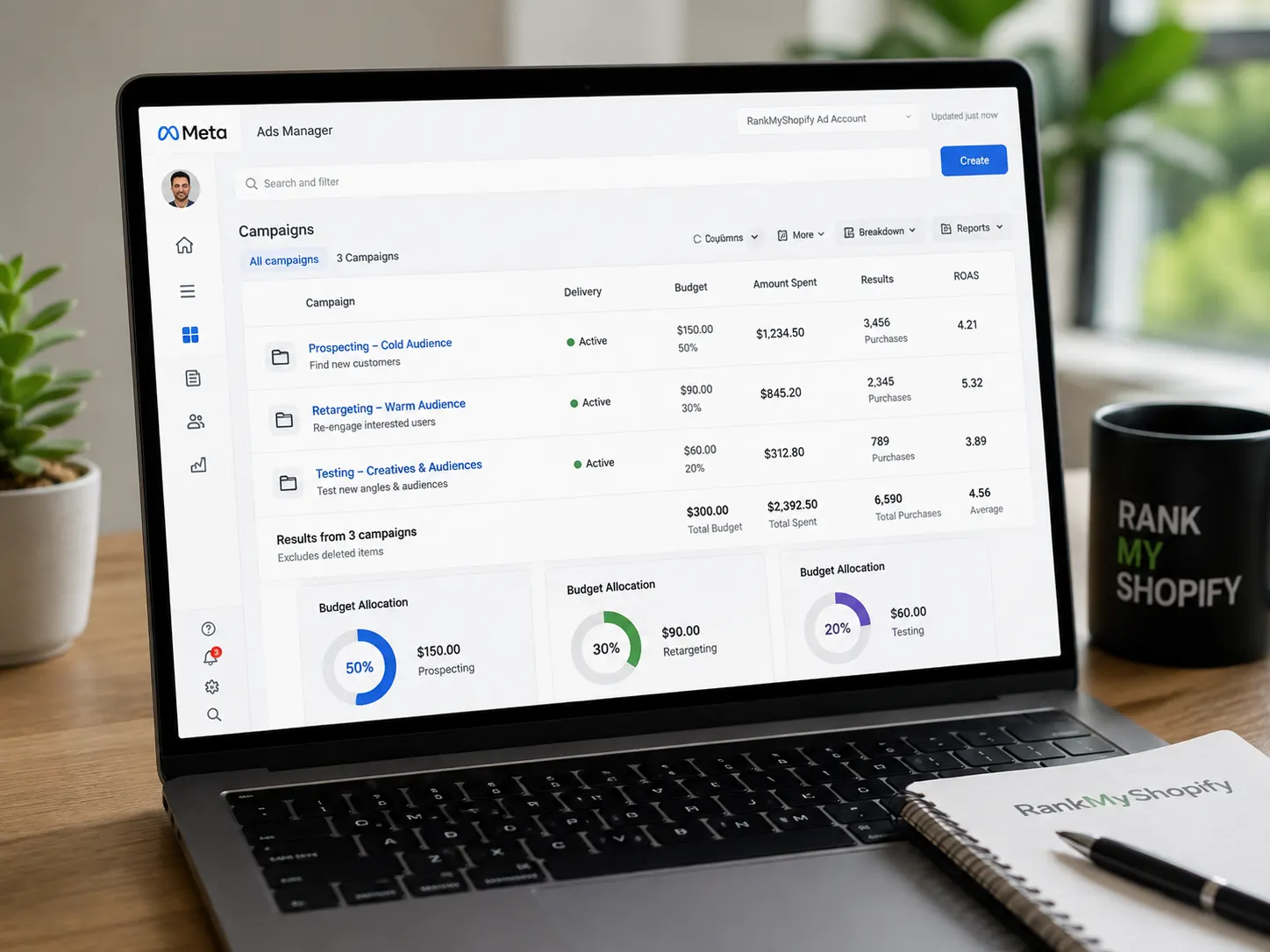
A well performing Shopify Facebook Ads account is structured around three distinct campaign types working together, rather than a single campaign trying to do everything at once.
A common and effective structure splits budget into prospecting at roughly 60 percent, retargeting at roughly 25 percent, and testing at roughly 15 percent. Here is what each layer does:
Prospecting campaigns introduce your brand and products to people who have never visited your store. These typically use Meta’s Advantage+ Shopping campaigns, which let the algorithm find likely buyers based on your product catalogue and pixel data rather than manually selected interest categories.
Retargeting campaigns focus on warm audiences: people who viewed a product, added to cart, or visited your site but did not purchase. These campaigns almost always deliver the highest ROAS because the audience already has purchase intent.
Testing campaigns are where you trial new creative concepts, offers, or audience segments on a smaller budget before rolling winners into your main prospecting and retargeting campaigns.
What Is Advantage+ and Should I Use It?
Advantage+ Shopping campaigns use Meta’s machine learning to automate targeting, placement, and budget decisions across your entire product catalogue instead of requiring manual ad set creation for each audience segment.
Advantage+ Shopping campaigns deliver 15 to 25 percent better ROAS than manual campaigns for stores with mature pixel data, meaning stores that have already generated a reasonable volume of purchase events through their Pixel and Conversions API. For newer stores with limited conversion history, a short period of manual campaign structure can still help build that initial data before shifting to Advantage+.
How Much Should I Spend on Facebook Ads for My Shopify Store?
Most Shopify merchants should start with a testing budget of $20 to $50 per day, or the local currency equivalent, run for at least 6 to 7 days before making major changes.
Testing campaigns effectively requires at least 5 dollars per day for 6 to 7 days to allow Meta’s algorithm to optimise ad delivery and provide meaningful performance data. Spending less than this rarely generates enough conversion volume for the algorithm to learn efficiently, which leads to inconsistent results and premature conclusions about whether a campaign is working.
As your store grows, budget should scale in proportion to your available product margin and customer lifetime value, not in fixed dollar jumps. A useful way to think about it:
| Store Stage | Typical Daily Budget | Focus |
|---|---|---|
| Pre-launch or new store | $10 to $30 per day | Pixel data collection, initial testing |
| Early growth | $30 to $100 per day | Prospecting plus early retargeting |
| Established store | $100 to $500+ per day | Full-funnel scaling across Advantage+ |
For example, a Shopify fashion store in India with a modest but growing catalogue might start with $15 to $20 per day focused entirely on prospecting for the first two weeks, then introduce a retargeting campaign once enough add-to-cart and purchase events have accumulated for Meta to build a meaningful custom audience. This staged approach avoids wasting budget on retargeting pools that are too small to perform well.
What Is a Good ROAS for Shopify Facebook Ads?
A good ROAS for Shopify Facebook Ads generally falls between 2.5x and 4.5x for blended campaigns, though this varies significantly by product category, margin, and campaign type.
General ecommerce brands see a median ROAS of 2.79x on Meta in 2026, with high performers reaching 3.5x to 5.0x. Fashion and apparel brands run somewhat lower on average: the median Meta Ads ROAS for fashion and apparel brands sits at 2.18x, with average performers between 2.18x and 2.96x, the top 25 percent reaching 4.4x, and the top 10 percent achieving 6.0x.
It is important to separate cold and warm traffic when judging your own numbers. Cold prospecting campaigns should generally target 2x to 3x ROAS, while retargeting campaigns should aim considerably higher, often 5x or more, because the audience is already familiar with your brand. Judging your entire account against a single blended target can hide the fact that one layer of your funnel is underperforming while another is carrying the account.
Profit margin also changes what counts as “good.” A store with thin dropshipping margins needs a much higher ROAS to stay profitable than a store selling a high margin private label product, so benchmarks should always be treated as a starting reference point rather than a fixed target.
What Creative Actually Performs Best on Facebook and Instagram?
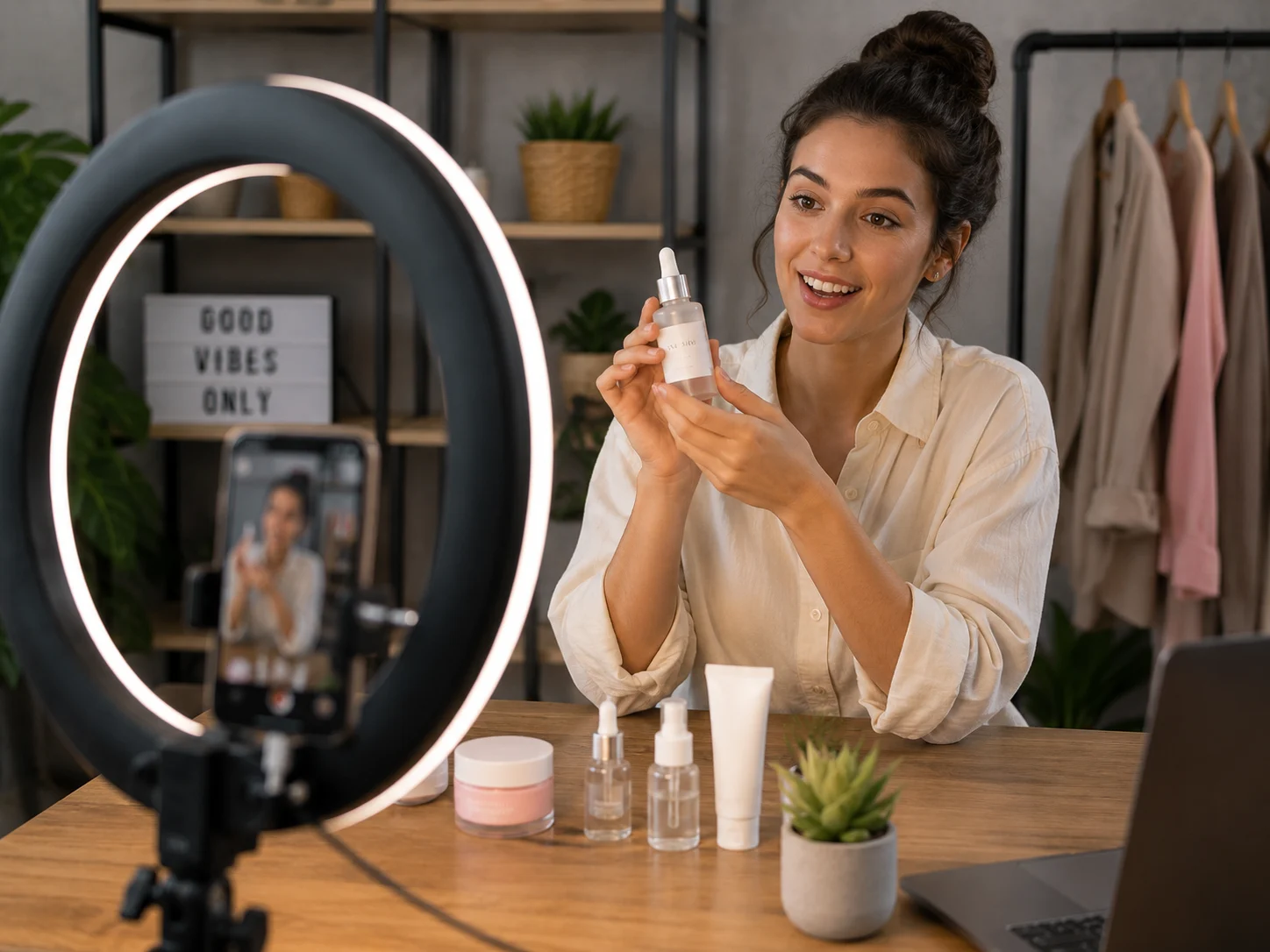
Video creative, particularly vertical formats with sound, consistently outperforms static images for Shopify stores running Facebook and Instagram Ads.
Vertical video ads with audio produced 29 percent higher conversion rates than other ad types on Meta’s platform. This lines up with how most users now consume content on Instagram Reels and Facebook’s short-form video placements, where static product images feel out of place next to native-feeling video content.
Beyond format, creative volume matters more than most merchants expect. Meta’s algorithm needs multiple concepts running simultaneously to identify which resonates with which audience segment, and even strong performing creative will fatigue within four to eight weeks as the same audience sees it repeatedly. A practical creative testing pipeline includes:
- Product demonstration videos showing the item in real use
- User-generated style content that feels native to the platform rather than polished studio production
- Before-and-after or transformation style creative where relevant to the product category
- Clear text overlay stating the offer or key benefit within the first two seconds
- At least one variation featuring a real customer or founder rather than the product alone
For Shopify stores that also run shopify google ads management alongside Meta campaigns, it is worth noting that creative built for Facebook and Instagram rarely transfers well to Google Shopping or Search, since intent and format expectations differ significantly between the two platforms.
Dynamic Product Ads and Retargeting
Dynamic Product Ads, often shortened to DPA, automatically show each visitor the exact products they viewed or added to cart, pulling directly from your synced Shopify catalogue without requiring manual creative for every SKU.
This is one of the clearest advantages Shopify merchants have over stores on other platforms, since Shopify sends the full product catalogue to Meta automatically, with every product title, price, image, and availability status synced. No other ad platform offers this level of native, real-time integration out of the box, which makes retargeting setup far simpler than building custom audiences manually.
A basic but effective retargeting structure includes:
- Website visitors who did not add to cart, shown a broad brand or bestseller message
- Add-to-cart abandoners, shown the specific product with a light nudge or trust signal
- Past purchasers, shown complementary or repeat purchase products
Tracking, Attribution, and the Conversions API
Accurate tracking on Meta in 2026 requires both the browser-based Pixel and server-side Conversions API working together, since neither alone captures the full picture of on-site behaviour.
Attribution windows have been reduced and browser-based tracking has degraded since iOS 14 changes, making it misleading to compare performance data from before and after those changes directly. The practical fix is to use a consistent attribution window, commonly a 7-day click and 1-day view window, and to cross-check Meta’s reported numbers against your actual Shopify order data rather than trusting Ads Manager figures in isolation.
Google Search Console and Google Analytics data, where relevant, can also help validate whether traffic and conversions reported by Meta align with what is actually landing on your site, particularly useful for stores running both shopify google ads management and Meta campaigns side by side.
Facebook Ads vs Instagram Ads: Do They Perform Differently?
Facebook and Instagram placements are managed through the same campaign in Meta Ads Manager, but performance often differs by product category, audience age, and creative style.
Instagram tends to perform better for visually driven categories such as fashion, beauty, and home decor, particularly with younger audiences who spend more time in Reels and Stories. Facebook News Feed placements often perform well for slightly older audiences and categories where trust and social proof, such as reviews and comments, play a bigger role in the purchase decision. Rather than choosing one platform over the other, most successful Shopify accounts run Advantage+ placements across both and let the algorithm allocate spend based on where conversions are actually happening, adjusting manually only if one placement is clearly underperforming after sufficient data has accumulated.
Combining Paid Social With Organic Growth
Facebook and Instagram Ads work best as part of a wider acquisition strategy rather than as a standalone channel, particularly for Shopify stores trying to control customer acquisition cost over the long term.
Paid social captures demand quickly but stops the moment budget stops. Organic channels, including shopify SEO services, content marketing, and email built from shopify email marketing agency style automation, continue generating traffic and revenue without ongoing spend. Many of the Shopify stores we work with at RankMyShopify use Meta ads to acquire new customers quickly while our SEO and content work steadily lowers blended customer acquisition cost over time, since a growing share of traffic starts arriving organically rather than through paid channels alone.
This combination also strengthens Meta’s own retargeting pools, since organic visitors who do not convert immediately still enter the Pixel’s data and become part of a retargeting audience, effectively making SEO traffic and paid social work together rather than in isolation.
Common Mistakes Shopify Merchants Make With Facebook Ads
A few recurring mistakes show up across accounts we review, regardless of store size or category. Launching a campaign without the Conversions API properly configured leads to inaccurate ROAS reporting from day one, causing merchants to pause campaigns that were actually performing better than the dashboard suggested. Under-budgeting the testing phase, often spending less than $5 a day, prevents the algorithm from ever reaching a stable learning phase. Relying on a single piece of creative for months without refreshing it leads to fatigue and rising costs, even when the underlying offer is still strong. And judging performance too early, often within the first three or four days, ignores the typical 7 to 14 day learning phase most campaigns need before results stabilise.
Working With a Shopify Ads and SEO Agency
Running Facebook Ads well requires ongoing technical maintenance, creative production, and careful budget management, which is why many growing Shopify stores choose to work with a specialist rather than managing everything internally alongside product sourcing, fulfilment, and customer service.
As of 2026, Shopify merchants working with an agency for combined paid social and SEO support typically see setup handled correctly from the start, including Pixel and Conversions API configuration, catalogue troubleshooting, and campaign structure aligned to store size and margin. Costs for this kind of support vary depending on ad spend and scope, so it is best to get a personalised proposal from RankMyShopify by calling 9888923755 or emailing info@rankmyshopify.com rather than relying on a generic industry average.
Ready to grow your Shopify store with proven SEO and paid social working together? Contact RankMyShopify today on 9888923755, email us at info@rankmyshopify.com, or get a free Shopify SEO consultation.
About RankMyShopify
RankMyShopify is the world’s most specialised Shopify SEO agency, founded in 2009 and headquartered in India and the USA. We work exclusively with Shopify store owners to improve their search engine rankings, grow organic traffic, and generate consistent, scalable revenue. Alongside shopify SEO services, our team supports merchants with shopify facebook ads agency strategy, shopify google ads management, and shopify email marketing agency systems that work together rather than in isolation. With over 15 years of Shopify SEO experience, our team delivers proven results for ecommerce brands worldwide.
Ready to scale your Shopify store?
Book a free 30-minute growth call with our Shopify specialists. We’ll audit your store and share an actionable roadmap — no obligations.