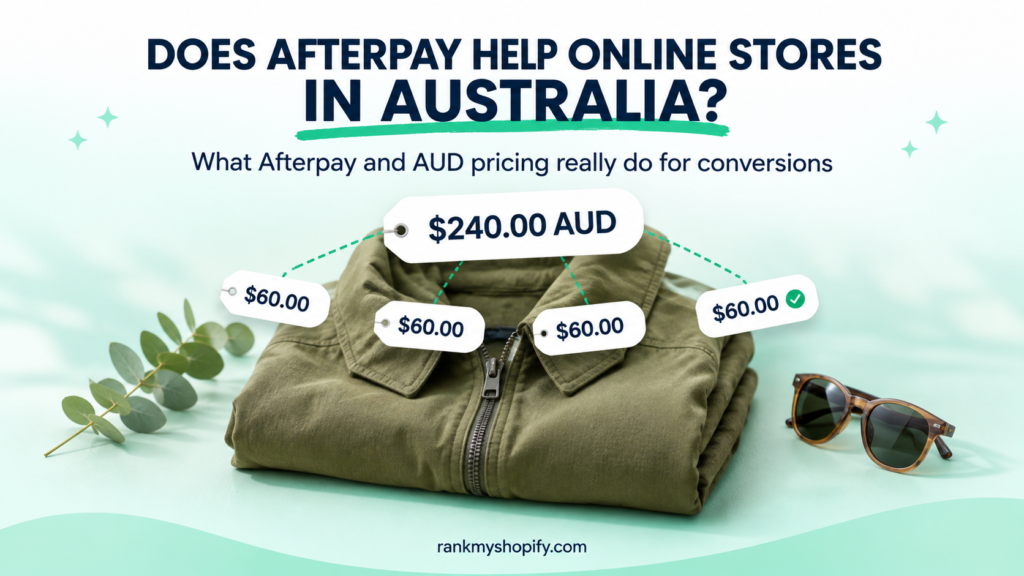
Imagine a shopper in Brisbane who loves a $240 jacket but hesitates at the price. When the product page shows four small payments instead of one big one, that hesitation often disappears. That raises a question every store owner asks: does Afterpay help online stores in Australia, or is it just another fee? This guide looks at what Afterpay and AUD pricing can and cannot do for sales, search visibility and trust, and how to set both up on Shopify.
Does Afterpay Help Online Stores in Australia?
Often yes, but it is not a guaranteed lift, and the strongest numbers come from Afterpay itself. Afterpay reports that its active shoppers have an average order value 28 percent higher than other shoppers, and that 37 percent of its merchants report larger basket sizes. A cookware brand in one Afterpay case study saw conversion rise by 7 percent after it started displaying Afterpay on its pages.
Treat those figures as a sign of what is possible, not a promise. They come from the provider and from selected merchants. Independent advisers also warn that buy now pay later can bring higher return rates, merchant fees and extra support work. The honest answer is that Afterpay tends to help most when your products are priced high enough for instalments to matter, and you should measure the result on your own store.
How Do Buy Now Pay Later Conversions Improve?

They improve because splitting a price into four payments lowers the barrier at the moment of decision. The shopper sees a smaller number today, and checkout feels easier. Buy now pay later conversions usually improve in three ways:
- Fewer abandoned carts. Shoppers who would pause at a larger total are more likely to finish the order.
- Bigger baskets. Instalments make it easier to add an extra item or choose a higher-priced option.
- Trust at checkout. A familiar payment brand reassures first-time buyers who do not know your store yet.
It helps most with fashion, beauty, jewellery, homewares, fitness gear and other products where the price sits above the impulse-buy range. It helps less with low-priced consumables, and it is rarely useful for business buyers who pay on invoice.
Does Afterpay Help SEO and Rankings?
Not directly. There is no sign that Google ranks a store higher because it offers Afterpay, and you should be wary of anyone who claims otherwise. The benefit is indirect.
Afterpay can improve what happens after the click, which is what makes your organic traffic pay off. If more visitors buy, each SEO visit is worth more. The pay in four message also adds useful information to your pages, and shoppers do search for phrases such as “buy jackets afterpay”. Afterpay also runs a shop directory that can send referral traffic to merchants, although those results are reported by Afterpay and will vary.
The practical rule is to put the message next to the price on each page. Our guide to Shopify product page SEO explains how to write product pages that answer both shoppers and search engines.
Why Does AUD Pricing Matter for Australian Shoppers?
AUD pricing matters because shoppers should never have to guess what they will pay. When a store shows prices in another currency, Australian buyers have to convert in their heads, and many worry about card conversion fees. Many leave rather than risk a surprise.
Getting AUD pricing Australia shoppers trust takes more than swapping a symbol. Check that you:
- Show prices in Australian dollars from the first page, and write “AUD” or “A$” where a plain dollar sign could be confused with USD
- Include GST in the displayed price for consumers
- Show shipping costs in AUD, and show your free shipping threshold in AUD too
- Use price endings your market expects, such as $49.95 or $50
- Keep the same price everywhere, including ads, feeds and emails
How Does AUD Pricing Help Search and Shopping Visibility?
It keeps your product data consistent, and consistent data is easier for Google to trust. If your Google Merchant Center feed shows one price or currency and your page shows another, products can be disapproved, and shoppers lose confidence when they click through.
For Australian stores, make sure that:
- Your Merchant Center feed targets Australia and uses AUD
- Your Product structured data uses the AUD currency code and matches the visible price
- Your page language and region settings point to Australian English
- Your shipping and tax settings in the feed match the store
These checks are part of everyday Shopify SEO, and they also support free product listings and Google Shopping ads.
How Do You Set Up Afterpay and AUD Pricing on Shopify?
Set your Australian market to AUD first, then add Afterpay and its messaging. A simple order of work:
- Set Australia as a market in Shopify Markets, with AUD as the selling currency and GST-inclusive prices.
- In your Shopify admin, go to Settings, then Payments, and add Afterpay as a payment method.
- Install Afterpay’s free On-Site Messaging app, and add its block to your product and cart page templates. It works on Shopify 2.0 themes, and it cannot be used to add Afterpay at checkout.
- Place a test order with Afterpay in AUD, and check the product page, cart and checkout.
- If you sell in several currencies, test Afterpay in each market. Some stores report that Afterpay can disappear at checkout when shoppers see a currency other than the store’s home currency.
If most of your sales are in Australia, keep AUD as your primary currency and add other markets carefully.
Where Should Afterpay Messaging Appear on a Product Page?
Put it directly under the price, in one short line, where the shopper is already looking. A line such as “or 4 payments of $60.00 with Afterpay” answers the price question at the moment it appears, and it needs no extra clicks.
Keep these points in mind:
- Show the same message on the cart page, so the offer does not disappear before checkout
- Check that the message updates automatically when you change a price or run a sale
- Test it on mobile, where most shoppers browse, so it does not push the Add to Cart button down
- Use one clear badge, not a row of payment logos
- Make sure the amount shown matches your AUD price exactly, including GST
What Should You Watch Out For Before Offering Buy Now Pay Later?
Weigh the lift against the fees and the rules. Four points matter most:
- Fees. Afterpay charges merchants on each order, so your margin falls on every Afterpay sale. Check the current rates in your agreement.
- Regulation. Since 10 June 2025, buy now pay later providers in Australia need a credit licence, and Afterpay now runs credit checks on new customer applications. Some shoppers may be declined.
- Surcharges. From 1 October 2026, businesses cannot surcharge eftpos, Mastercard or Visa payments. Buy now pay later and PayPal sit outside that ban. Check your Afterpay agreement for the current rules on passing on fees, and ask an adviser before you add any surcharge.
- Returns. Instalments can make impulse buying easier, so track your return rate for Afterpay orders.
Describe the offer accurately on your site, and avoid claims such as “free” or “no cost” unless they are strictly true.
How Do You Measure Whether Afterpay Is Worth It?
Compare the same metrics before and after you switch it on, and look at them for at least four weeks. Track:
- Conversion rate, and especially cart-to-order conversion
- Average order value for Afterpay orders compared with other orders
- Share of orders paid with Afterpay
- Return rate and refund value on Afterpay orders
- Profit after fees, not only revenue
- Support tickets linked to payments
Your Shopify reports and GA4 can show orders by payment method. If conversion and order value rise by more than the fees and returns cost you, Afterpay is paying for itself. If not, try showing the message more clearly before you drop it. Strong Shopify conversion rate optimization work starts from measurements like these.
Afterpay and AUD pricing will not fix a weak store, but they remove two common reasons Australian shoppers leave. Start with clear AUD prices, then add Afterpay on your higher-priced products and test the result.
About RankMyShopify
RankMyShopify is a Shopify marketing agency founded in 2009, with offices in Punjab, India and the USA. We help ecommerce brands in India, the USA, the UK, Australia and Canada with Shopify SEO, Google Ads, Meta Ads, CRO, content marketing and AI search optimisation. If you want to turn more Australian visitors into customers, talk to our team.
Ready to scale your Shopify store?
Book a free 30-minute growth call with our Shopify specialists. We’ll audit your store and share an actionable roadmap — no obligations.